


Part 1 of 2 — The Taiwan Story
When DEEPX first walked into COMPUTEX InnoVEX in 2023, we were a young Korean fabless startup with a bold bet: that the next frontier of AI wouldn’t be in the cloud — it would be in the physical world. Three years later, we’re back. Not as a startup on a stage, but as a company whose chips are running inside products from over 30 global hardware partners across the show floor.
This is the story of how that happened — and why Taiwan was always at the center of it.
Why COMPUTEX? Why Taiwan?
COMPUTEX TAIPEI isn’t just a trade show. It’s where the global hardware ecosystem decides what comes next. Nvidia, Qualcomm, Intel, Marvell, NXP — the CEOs of the world’s most influential AI and semiconductor companies come here to lay out their visions for the next generation of computing infrastructure.
For an AI chip company, there’s no more important room to be in.
Taiwan, more broadly, is the single most critical proving ground for any serious semiconductor business. Industrial PCs, embedded computing, servers, network equipment, storage, motherboards — if it runs AI at the edge, chances are it was designed, built, or distributed through Taiwan’s hardware ecosystem.
When DEEPX was deciding where to establish its global presence, the answer was clear. As our CEO Lokwon Kim put it: “If you want to catch a tiger, you have to go into the tiger’s den.”
2025 Computex Taipei
A Relationship Built Over Years
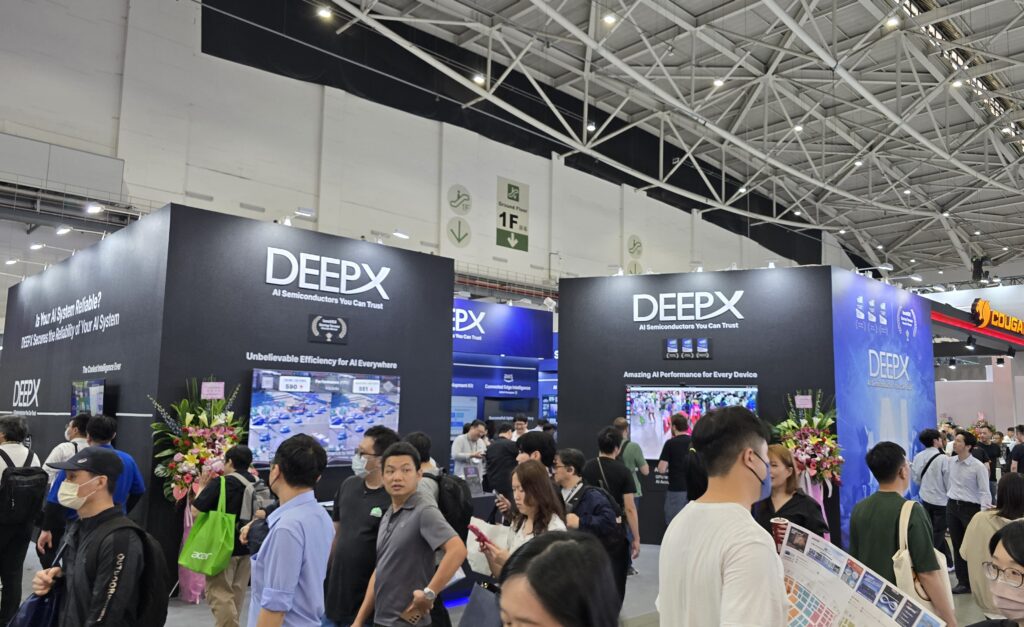
Our connection to Taiwan’s hardware industry didn’t begin this year. It didn’t even begin at COMPUTEX 2025, when we co-exhibited with more than 15 leading Taiwanese industrial PC and server companies.
It started in 2023, when DEEPX won the COMPUTEX InnoVEX Innovation Award — recognition that our ultra-low-power AI semiconductor technology had genuine potential in the edge AI market. That win opened doors. It started conversations. It put us on the radar of an ecosystem that evaluates companies not by where they’re from, but by what they’ve actually built.
In 2024, Digitimes — Taiwan’s most influential IT industry publication — placed an interview with our CEO directly opposite their feature interview with Nvidia’s Jensen Huang. The message was clear: DEEPX was being watched as one of the next significant players in on-device AI semiconductors.
What we found in Taiwan surprised us. CEO Kim reflected on it this way: “What I actually experienced in the Taiwan market wasn’t barriers or bias against foreign companies. It was a remarkably open, merit-driven ecosystem — one that evaluates technology and product competitiveness on its own terms, and connects you with better partners when you prove yourself.”
That openness is why DEEPX was able to build deep, early-stage partnerships with Taiwan’s hardware ecosystem while many larger Korean companies were still deciding whether to show up.
The Shift: From Award Winner to Ecosystem Player
Between 2023 and today, something fundamental changed for DEEPX.
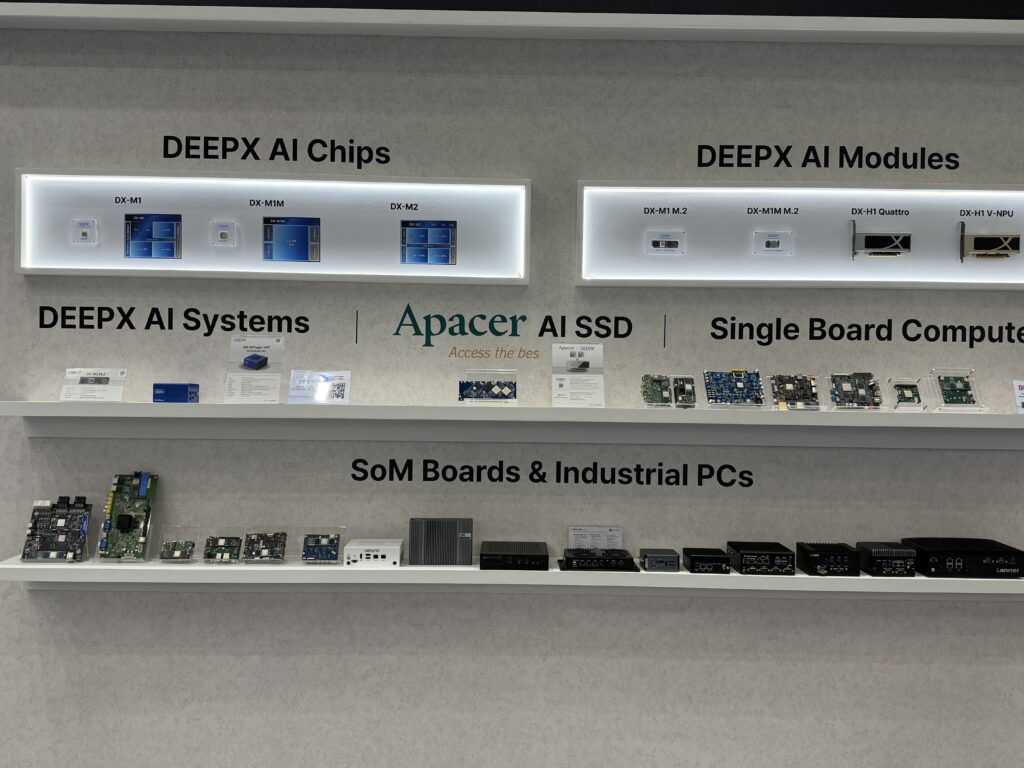
We went from a company demonstrating technology to a company shipping products. In August last year, we launched our first commercial AI semiconductor and module lineup into mass production. That transition — from tech validation to commercial deployment — changes everything about how the industry sees you.
It changes the conversations you can have. It changes the partnerships available to you. And it changes what you can show at an event like COMPUTEX.
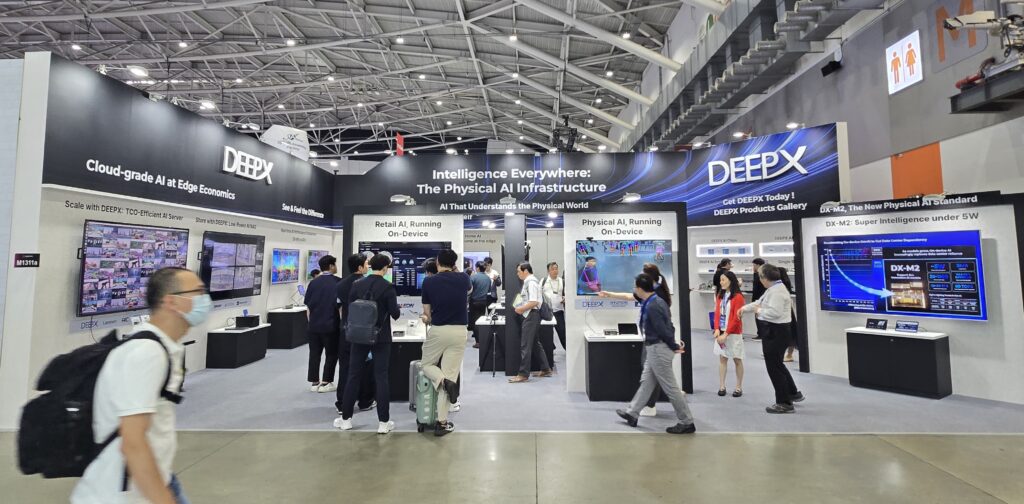
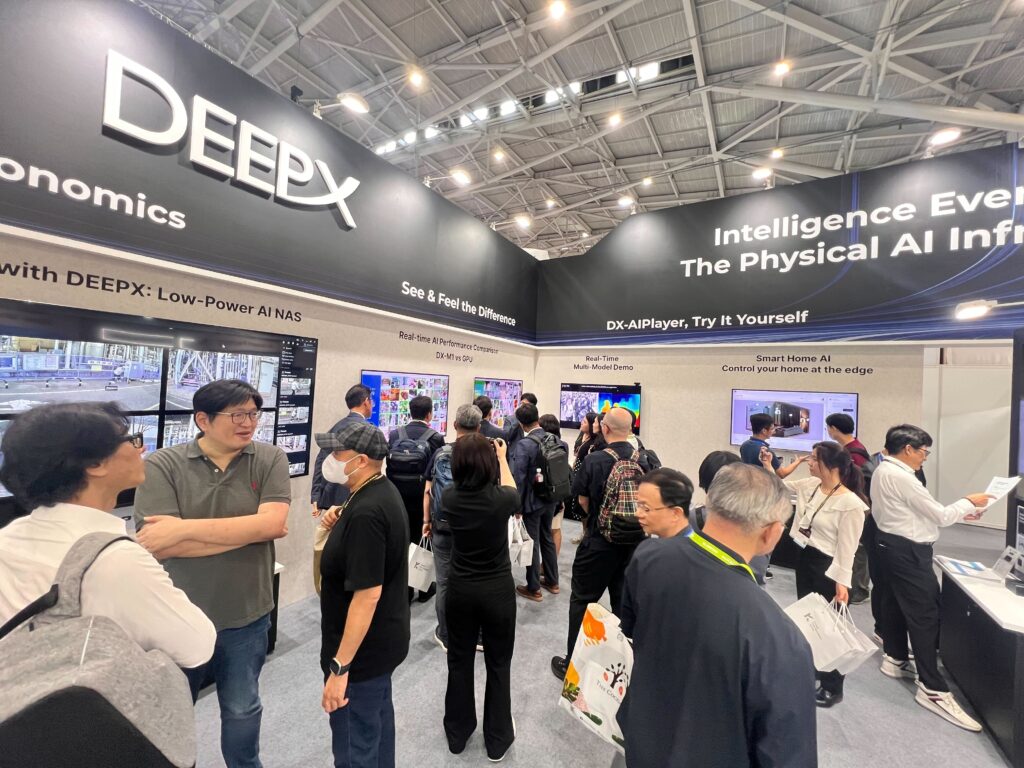
At COMPUTEX TAIPEI 2026 (June 2–5, Taipei, Taiwan), DEEPX will operate its own dedicated exhibition booth — but more importantly, our products will appear simultaneously across the official booths of over 30 global hardware manufacturers, system integrators, and software partners.
Those partners include: Advantech, ASRock, MSI, AAEON, QNAP, BIOSTAR, Apacer, Lanner, iEi, Portwell, Aetina, Sintrones, ARBOR, DFI, Axiomtek, and more — alongside global distribution partners Avnet and WPG.
This is what it looks like when a fabless semiconductor company becomes part of the global hardware infrastructure.
What Is Physical AI, and Why Does It Matter Now?
The global AI industry has grown explosively around large language models and generative AI. But AI’s next wave is moving beyond data centers — into robots, factories, retail environments, city infrastructure, security systems, medical devices, and edge servers.
DeepX defines Physical AI as AI that operates inside real-world devices and systems, acting immediately at the point where data is generated. A robot recognizing its environment. A factory camera detecting defects in real time. A security system identifying anomalies on-site. A handheld medical device running AI analysis at a patient’s bedside.
This kind of AI can’t live in the cloud. It needs to run locally — with high inference performance, ultra-low power consumption, minimal latency, and a form factor that fits inside real hardware products.
That’s exactly what DEEPX’s NPU technology is built for. And Taiwan’s hardware ecosystem is exactly the right partner to bring it to market at scale.
What’s Coming in Part 2
In our next post, we’ll walk through the seven Physical AI solution categories DEEPX is showcasing at COMPUTEX 2026 — from robotics platforms and smart factories to AI NAS, edge servers, and healthcare. We’ll also explain what it means for our products to be running across 30+ partner booths simultaneously, and what that signals about where the Physical AI ecosystem is headed.